
If you run a small service business or affiliate site, your hesitation about automated blog content is probably not irrational. In many cases, it is exactly the right instinct.
A lot of AI-written content does read thin, repetitive, generic, and strangely confident about facts it has not earned the right to state. Some of it is embarrassing on contact. Some of it quietly undercuts trust. Some of it never ranks because it adds nothing new. And some of it ranks for a while, then becomes a liability because no one built a process to keep it accurate.
So let’s be direct: the strongest objection to AI writing is not that “Google hates AI.” It is that too many businesses use AI as a substitute for editorial judgment, subject knowledge, and quality control.
That distinction matters. Because if your real fear is hurting brand credibility or search performance, the enemy is not automation itself. The enemy is publishing low-accountability content at scale.
The thesis of this article is simple: AI content quality is not determined by whether a machine helped draft it, but by whether a serious system exists around briefing, review, fact-checking, voice control, and usefulness. Businesses that understand this can use automated blog content responsibly. Businesses that do not will produce the exact “AI slop” they are trying to avoid.
Does Google penalize AI content?
Short answer: Google does not penalize content simply because AI was used to create it. Google’s public position has consistently focused on content quality, usefulness, and people-first value, not on whether the draft originated from a human, an AI assistant, or a hybrid workflow.
That answer is important, but incomplete.
Many business owners ask, “Does Google penalize AI content?” when what they really mean is:
- Will generic automated articles fail to rank?
- Will low-quality AI pages weaken my site overall?
- Will factually sloppy content damage trust signals?
- Will pages without real expertise or originality be ignored?
To those questions, the answer is much less comforting.
Google does not need an anti-AI rule to filter out weak content. It can simply reward pages that are more useful, clearer, better aligned with search intent, more trustworthy, and more satisfying than yours. In practice, that means a business can lose traffic with AI content without ever being “penalized” for AI content.
This is why the simplistic debate—AI good versus AI bad—misses the point. The practical question is: Can your content workflow consistently produce pages that deserve to exist?
If not, the issue is not automation. It is standards.
Why does so much automated blog content feel cheap?
Because in many cases, it is cheap in the wrong place.
Businesses often try to save effort at the exact stage where quality is decided: the brief. They ask a system to “write a blog post about plumbing tips” or “create an SEO article about personal injury law” and then judge AI by the uninspired result. But vague input almost guarantees vague output.
The common failure modes are predictable:
- No editorial angle: the article covers a broad topic with no thesis, no point of view, and no reason to read it instead of the other fifty pages on the same subject.
- No audience definition: the draft talks to “everyone,” which means it speaks to no one in particular.
- No factual guardrails: the system fills gaps with plausible-sounding filler, outdated claims, or oversimplified advice.
- No brand voice constraints: the tone becomes bland, inflated, or mismatched to how the business actually communicates.
- No review process: weak claims, repetition, and soft inaccuracies survive into publication.
In other words, people often blame the writing engine for failures that began in strategy.
A useful comparison is architecture. If a builder receives a vague sketch, unclear measurements, and no site assessment, you do not blame the concrete for the bad house. Yet that is how many companies evaluate AI writing: they give it a poor blueprint and then treat the draft as proof that the technology itself cannot produce quality.
That is backwards. The quality of the brief determines the ceiling of the output. The quality-control process determines whether the final article reaches that ceiling.
Can AI writing for business be safe for SEO if the brief is strong?
Yes—but only if “strong” means more than a topic and a keyword.
A strong brief does not merely request content. It narrows judgment. It tells the system what the article is for, who it is for, what it should avoid, and what counts as a good answer.
For businesses worried about AI content and SEO, a serious brief should include at least these elements:
- Search intent: what the reader is actually trying to decide, compare, or understand.
- Audience sophistication: whether the reader is a beginner, a cautious buyer, or someone comparing providers.
- Editorial thesis: the specific claim the article will defend, not just the general topic it will describe.
- Brand voice rules: measured, direct, technical, warm, skeptical, formal, plainspoken—whatever is true for your business.
- Boundaries: what claims the article must not make, what legal or medical caution is required, what promotional language to avoid.
- Evidence expectations: where facts need verification, where examples should come from, and where uncertainty should be acknowledged.
- Originality source: internal experience, recurring customer questions, service realities, regional nuance, pricing logic, process insights.
That last point is especially important for E-E-A-T. Many site owners think experience and expertise must appear as formal credentials only. But often they show up in more practical ways: the difference between what customers ask before buying and what they ask after; the mistakes people make before hiring; the trade-offs insiders know but generic articles ignore.
If your workflow can feed that kind of specificity into the draft, AI can become useful. If it cannot, automation tends to magnify mediocrity.
What parts of AI article creation should stay human?
This is where many quality-conscious businesses need a more mature framework. The choice is not “fully human” or “fully automated.” The responsible question is: Which parts benefit from speed, and which parts require judgment?
Here is the blunt version.
Good candidates for automation:
- Turning a clear brief into a first draft
- Generating structural variations for headings and intros
- Expanding known service explanations into readable prose
- Refreshing formatting, internal summaries, and FAQ structures
- Maintaining publishing consistency over time
Better kept under human control:
- Choosing the article angle and thesis
- Making claims about outcomes, regulations, health, law, or finance
- Injecting real customer insight and lived operational knowledge
- Approving tone and brand fit
- Final factual review
- Deciding whether the article is genuinely useful enough to publish
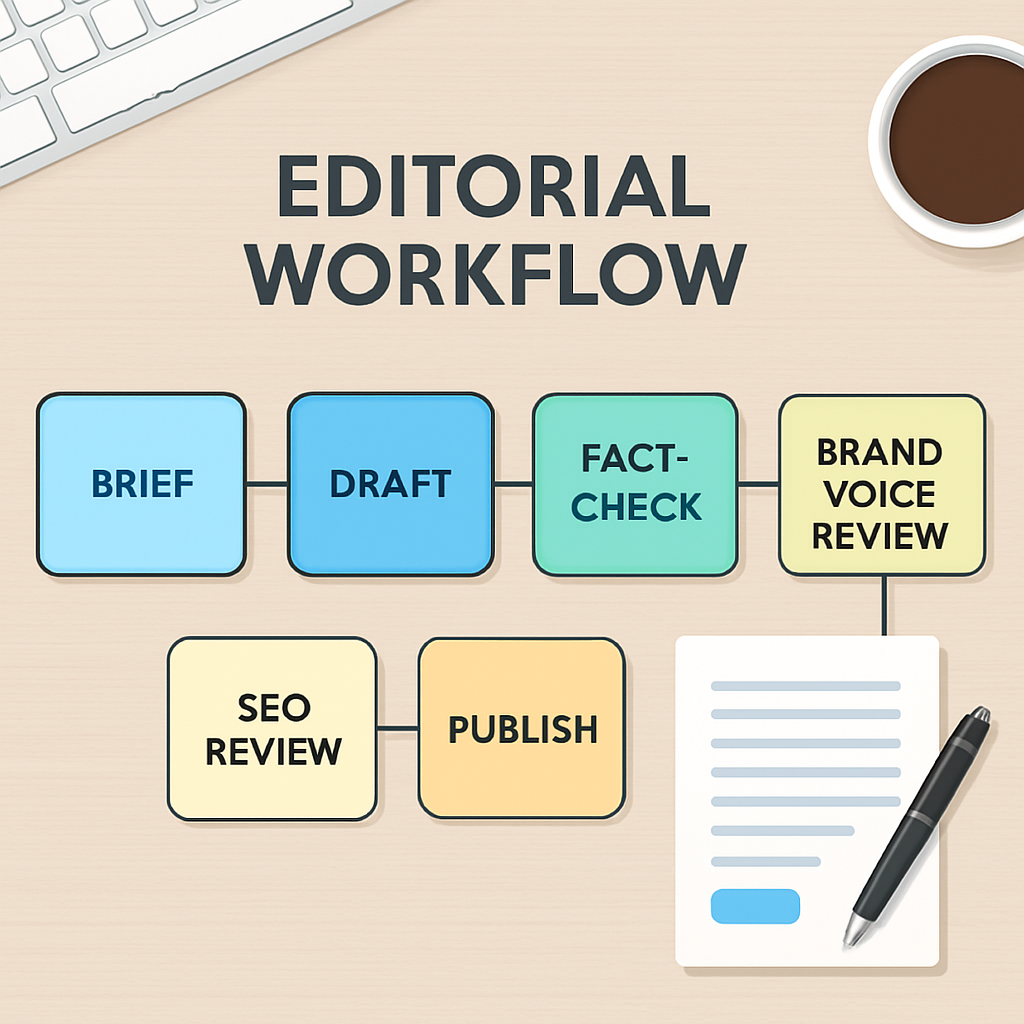
This division solves a false dilemma. You do not need to choose between exhausting manual writing and reckless auto-publishing. You need a workflow where machines handle repeatable drafting work and humans retain authority over relevance, truthfulness, and reputation.
That is not anti-AI. It is what responsible adoption looks like in any other business function.
How do you control AI content quality at scale without reading like a robot?
The answer is to standardize the checks, not flatten the voice.
Many businesses fear that process will make content feel sterile. But inconsistency is a bigger threat than structure. Readers do not trust a site that sounds expert on one page, salesy on another, and vaguely synthetic everywhere else.
A practical AI article quality control system should review each post for six things:
- Intent match: Does the article answer the question the searcher actually has?
- Factual integrity: Are claims verified, qualified, or clearly framed as general information rather than hard fact?
- Specificity: Are there concrete details, examples, distinctions, and trade-offs—or just padded explanations?
- Voice consistency: Does this sound like your business, not like a generic content engine?
- Original value: Does the page add a perspective, framework, or explanation competitors are not all repeating?
- Publication worthiness: Would you be comfortable sending this article to a serious prospect?
That last question is underrated. It cuts through vanity metrics. If a page is “fine for SEO” but you would hesitate to show it to a prospective client, then it is probably not fine. Search visibility and brand credibility should not be treated as separate content standards.
One useful discipline is to ban certain phrases unless they are earned by substance: “in today’s digital landscape,” “it is important to note,” “revolutionize your business,” “comprehensive guide,” and similar padding language. These expressions are not harmful because AI uses them. They are harmful because they signal empty writing.
Good business content sounds like someone who knows the subject is trying to help a reader decide well.
Is AI content bad for SEO when it lacks first-hand experience?
Often, yes—and this is where many automated content programs quietly fail.
For local service businesses and serious affiliate sites, first-hand experience is not a decorative bonus. It is often the difference between a page that feels interchangeable and one that earns trust.
Consider the contrast.
A generic article on “how to choose a roofer” will say to check reviews, compare quotes, and verify insurance. That is true, but forgettable.
A stronger article might explain why a very low quote often excludes decking replacement, why storm-season lead times change pricing behavior, what homeowners misunderstand about insurer documentation, or which questions reveal whether a contractor will subcontract the whole job. That kind of specificity reflects experience. It helps the reader make a better decision.
AI can express those insights clearly. It usually cannot invent them responsibly.
So when people ask whether AI writing for business can support E-E-A-T, the honest answer is: only if the business supplies the experience layer. The machine can help package, organize, and scale what you know. It should not be trusted to fabricate lived expertise your company has never articulated.
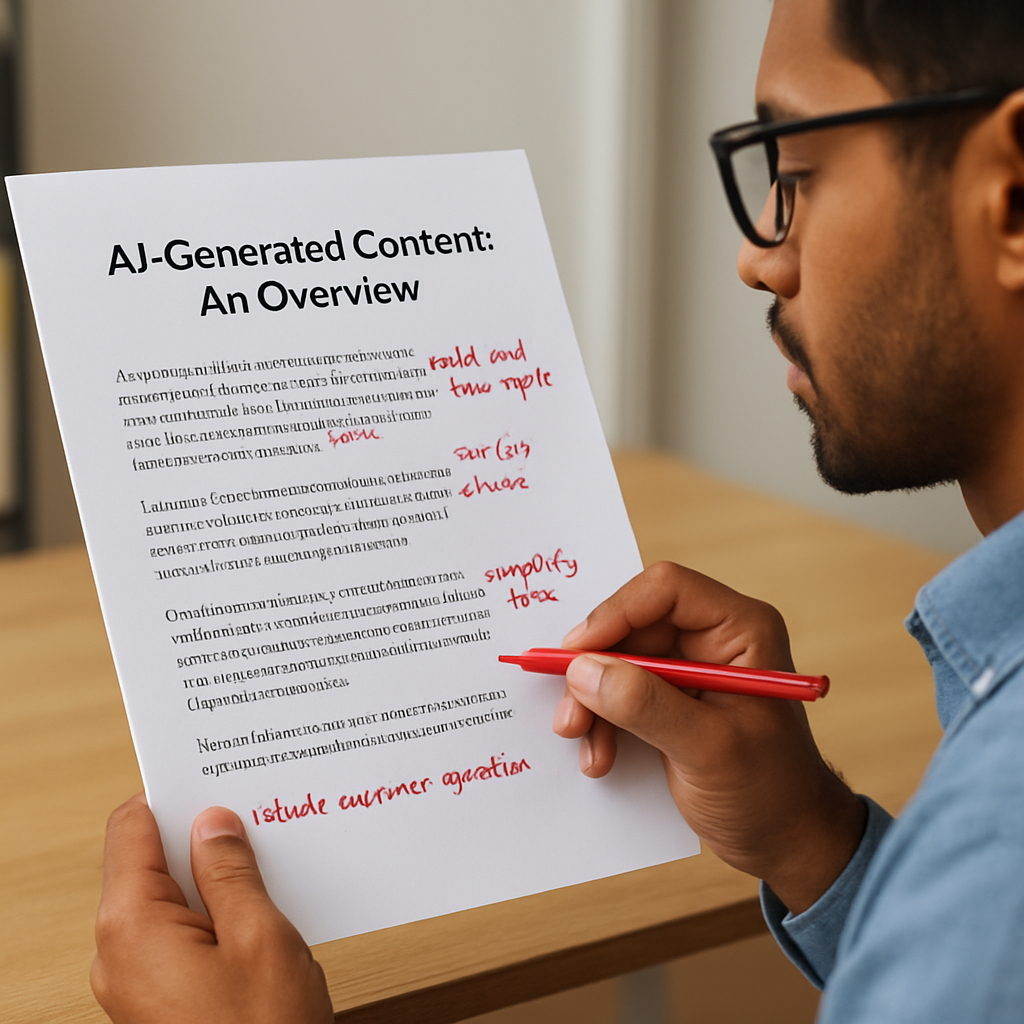
This is also why content briefs are not administrative paperwork. They are the mechanism by which your actual business intelligence enters the publishing system.
What is the biggest mistake businesses make with automated blog content?
Treating content production as the whole job.
For skeptical owners, this is the central mindset shift. Automated blog content is not primarily a writing shortcut. It is a publishing system. And any system can produce either assets or liabilities depending on its controls.
The biggest mistake is assuming the hard part is getting words onto the page. It is not. The hard part is deciding what should be said, what must be checked, and what is worth associating with your name month after month.
That mistake shows up in several ways:
- publishing high volumes of low-distinction articles
- confusing keyword coverage with authority
- failing to update aging informational posts
- allowing AI to make certainty-heavy claims in expertise-sensitive niches
- using one generic prompt for every article regardless of topic
The better approach is slower in design and faster in execution. Build the standards once. Define the voice once. Clarify what counts as useful once. Set review thresholds once. Then let automation operate inside those boundaries.
This is why well-briefed systems can be the responsible choice, especially for businesses that are not staffed like media companies. Without a system, content gets postponed, improvised, or outsourced carelessly. With a real system, the business can publish consistently without abandoning quality discipline.
So, can you trust AI to write your blog without hurting your brand?
You can trust a governed process. You should not trust raw generation alone.
That is the conclusion many business owners arrive at after looking past the slogans. “AI articles are slop” is not a serious argument unless it also explains which workflow produced them. Most bad AI content is bad for familiar reasons: weak briefs, no editorial angle, no review, no fact-checking, no voice control, and no meaningful contribution.
The more useful framing is this: automation lowers the cost of drafting, but it does not lower the standard required for publication. If anything, it raises the importance of standards because scale makes small weaknesses repeat faster.
For businesses that care about rankings and reputation, that is not bad news. It is clarifying news.
You do not need to become a writer to publish credible blog content. But you do need to act like a publisher. That means having a point of view, defining quality before generation begins, preserving human judgment where it matters, and refusing to publish pages that would make your brand look careless.
The businesses that win with AI content and SEO will not be the ones that pretend the risks are fake. They will be the ones that understand the risks clearly enough to build around them.
Deixe um comentário